
null vs Missing Key vs Empty String in JSON
Quick answer: In JSON, "x": null, an absent x, and "x": "" are three distinct states — "known to be empty," "not provided," and "a real blank value." Treating them as the same causes subtle bugs, especially in APIs and partial updates. Decide what each means in your schema and handle them explicitly. Check field presence and types with the JSON Validator.
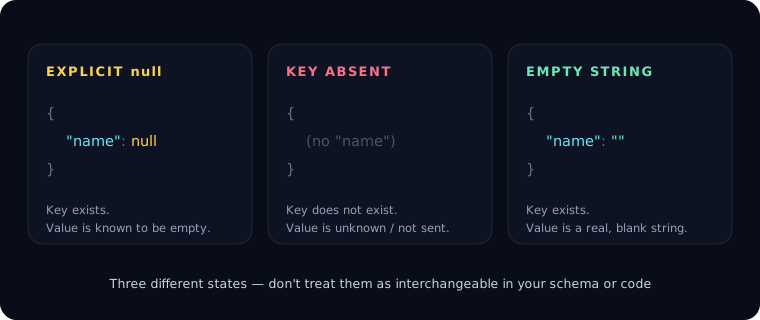
The three states
{ "name": null }     // key present, value explicitly empty
{ }                  // key absent — no "name" at all
{ "name": "" }       // key present, value is a real empty string
nullsays "this field exists and its value is intentionally nothing." For a date, that's "no date set." For a parent ID, "no parent."- Missing says "no information" — the field wasn't sent. In a partial update (
PATCH), an absent field usually means "don't change this." - Empty string is an actual value: a name that is the zero-length string, which is different from "no name."
Why the distinction matters
Partial updates (PATCH). This is the classic trap. If a client omits nickname, you should leave it unchanged. If the client sends "nickname": null, they're asking you to clear it. Collapsing missing and null together makes one of those impossible to express.
Defaults. value ?? "default" (nullish coalescing) treats both null and undefined/missing as "use the default," but treats "" as a real value. Picking the wrong operator (|| vs ??) changes behavior for empty strings and 0.
Validation. A schema can require a key to be present yet allow its value to be null — those are separate rules. See JSON Schema Basics.
Handling them in code
In JavaScript, distinguish presence from value:
if (!("name" in obj)) {
  // key missing — leave unchanged / no info
} else if (obj.name === null) {
  // explicit null — clear it
} else if (obj.name === "") {
  // real empty string
}
Note that reading a missing key yields undefined, but JSON itself has no undefined — JSON.stringify({a: undefined}) drops the key entirely, turning "undefined" into "missing." So a round-trip through JSON erases the difference between undefined and absent. See Parse and Stringify and The Six JSON Data Types.
Design guidance
- Document what each state means for every optional field in your API.
- Prefer omitting a field over sending
nullwhen "no value" and "not provided" are the same to you — it's smaller and clearer. - Use
nulldeliberately when a client needs to clear a value in an update. - Be consistent, and validate with a schema so the contract is enforced — the JSON Best Practices Checker can flag inconsistent null/empty usage.
Frequently asked questions
Is null the same as a missing key in JSON?
No. null is an explicit value meaning "intentionally empty"; a missing key means the field wasn't provided at all. In APIs, especially partial updates, they should be handled differently.
Is an empty string the same as null?
No. "" is a real, present value (a zero-length string). null means there is no value. Use the right one for your domain.
Does JSON have undefined?
No. JSON has null but not undefined. JSON.stringify drops keys whose value is undefined, so they become missing rather than null after serialization.
How should an API treat a missing field in a PATCH?
Conventionally, an absent field means "leave it unchanged," while an explicit null means "set it to empty/clear it." Document this so clients know how to express each intent.